All projects

1OverviewTP-SDE-2026 · Web Warehouse

TP-SDE-2026PJ-02

Web Warehouse

Full-stack inventory and PO management with a 3D warehouse model rendered in Three.js.
  • Next.js
  • Three.js
  • MongoDB
  • Tailwind CSS

2In the productTP-SDE-2026 · Web Warehouse

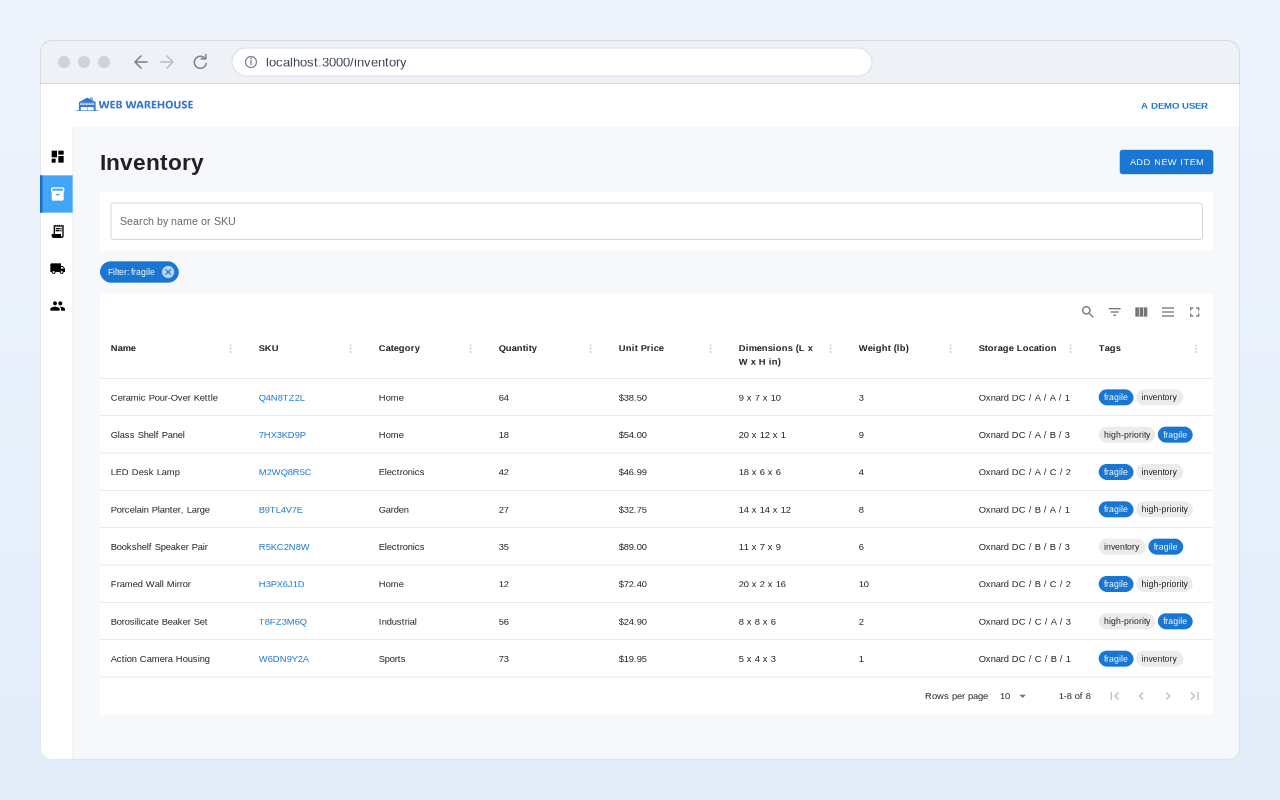
Inventory: Searchable inventory table filtered by the fragile tag, with SKU links, dimensions, weights, storage locations and tag chips.
Inventory. Searchable inventory table filtered by the fragile tag, with SKU links, dimensions, weights, storage locations and tag chips.
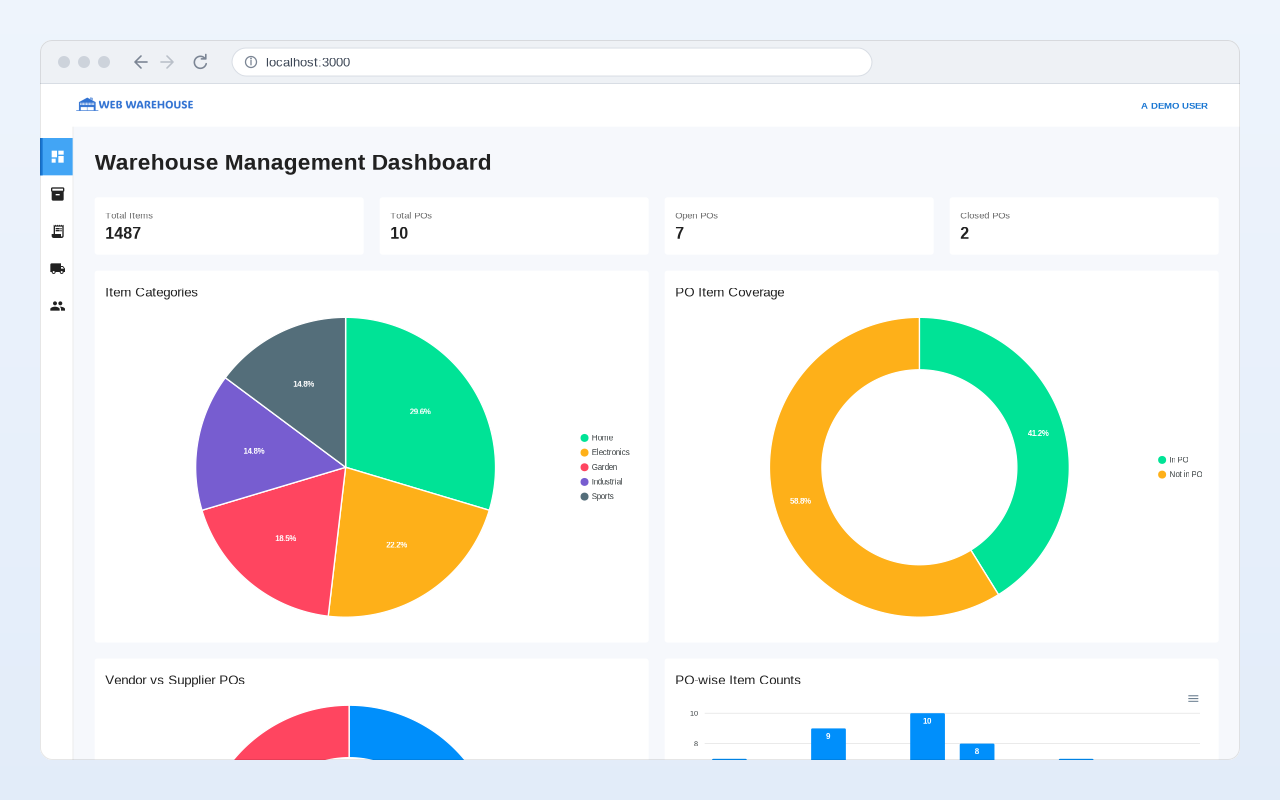
Dashboard: Stock and purchase-order stat cards with ApexCharts for item categories, PO item coverage, vendor vs supplier POs and item counts per PO.
Dashboard. Stock and purchase-order stat cards with ApexCharts for item categories, PO item coverage, vendor vs supplier POs and item counts per PO.
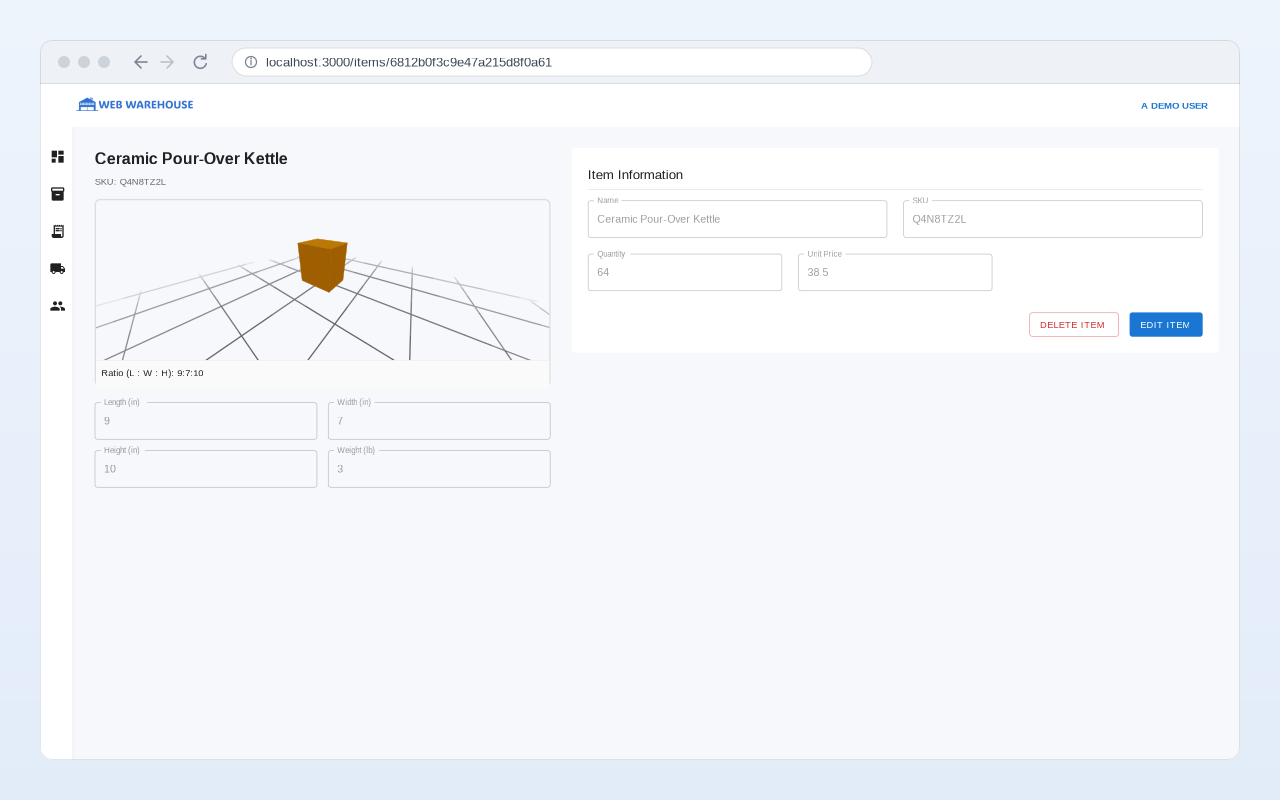
Item detail with 3D preview: A React Three Fiber box scaled to the item's length, width and height on a grid, next to the item's dimension and information fields.
Item detail with 3D preview. A React Three Fiber box scaled to the item's length, width and height on a grid, next to the item's dimension and information fields.
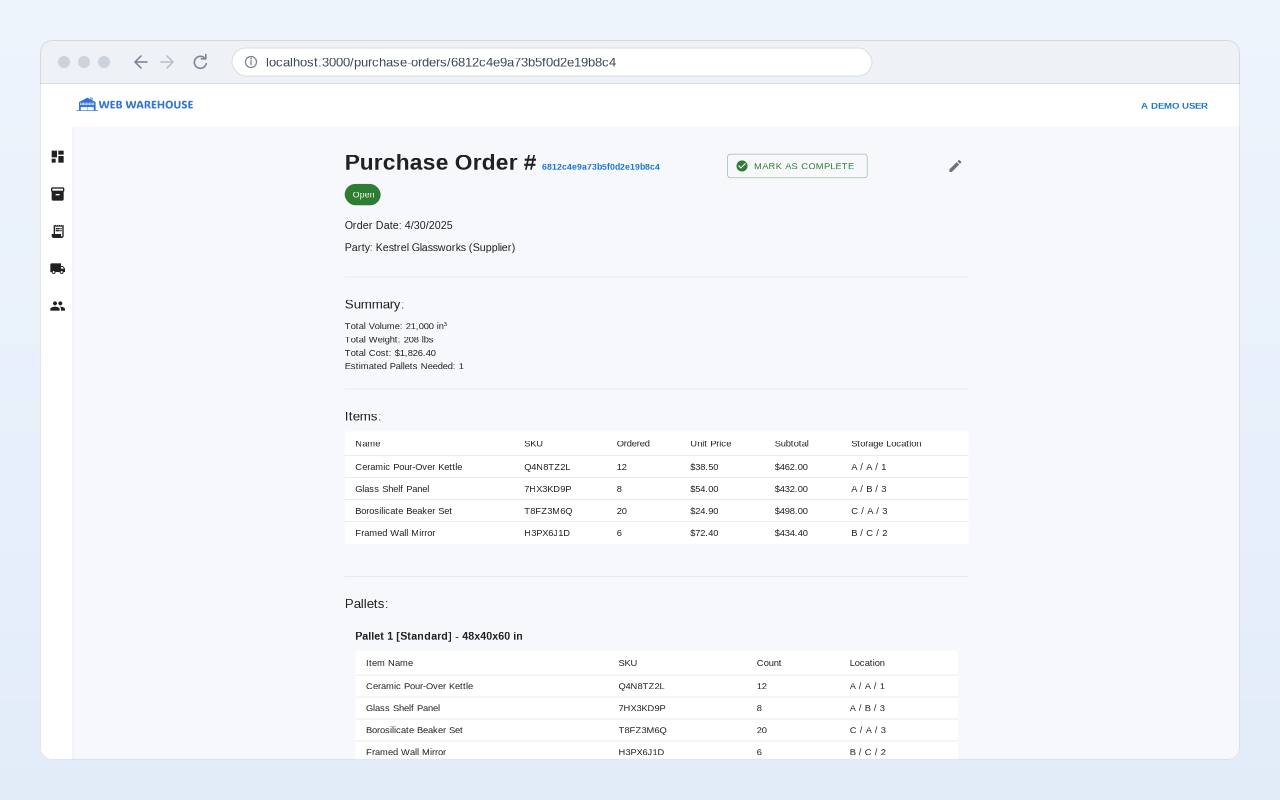
Purchase order: A supplier purchase order with its volume, weight and cost summary, ordered items and the Pallet 1 standard 48x40x60 in breakdown.
Purchase order. A supplier purchase order with its volume, weight and cost summary, ordered items and the Pallet 1 standard 48x40x60 in breakdown.

Screens are recreated from the app’s real UI with fictional demo data.

3Problem → solutionTP-SDE-2026 · Web Warehouse

The problem

Warehouse operators needed more than a flat table to understand where inventory lived, how pallets moved, and whether storage slots were efficiently utilized — especially when seeding or reviewing large purchase orders.

What I built

By modeling the physical warehouse hierarchy in MongoDB and projecting it into a Three.js 3D scene, operators can navigate the real layout, inspect individual items, and understand spatial utilization without leaving the browser.

Next.js 15 App Router warehouse system backed by MongoDB Atlas. Manages items, vendors, suppliers, purchase orders with embedded pallets, and renders the structured warehouse layout (unit → row → column) as an interactive 3D preview using Three.js. Dashboard analytics powered by ApexCharts.

4How it fits togetherTP-SDE-2026 · Web Warehouse

The physical warehouse is modelled in MongoDB Atlas as a Unit → Row → Column hierarchy, alongside items, vendors/suppliers, and purchase orders with embedded pallets. Next.js 15 App Router API routes serve that structure to the client, which renders it as a Three.js 3D scene and an ApexCharts dashboard. A dbScript seeder generates a realistic dataset so the whole flow can be demonstrated end to end.
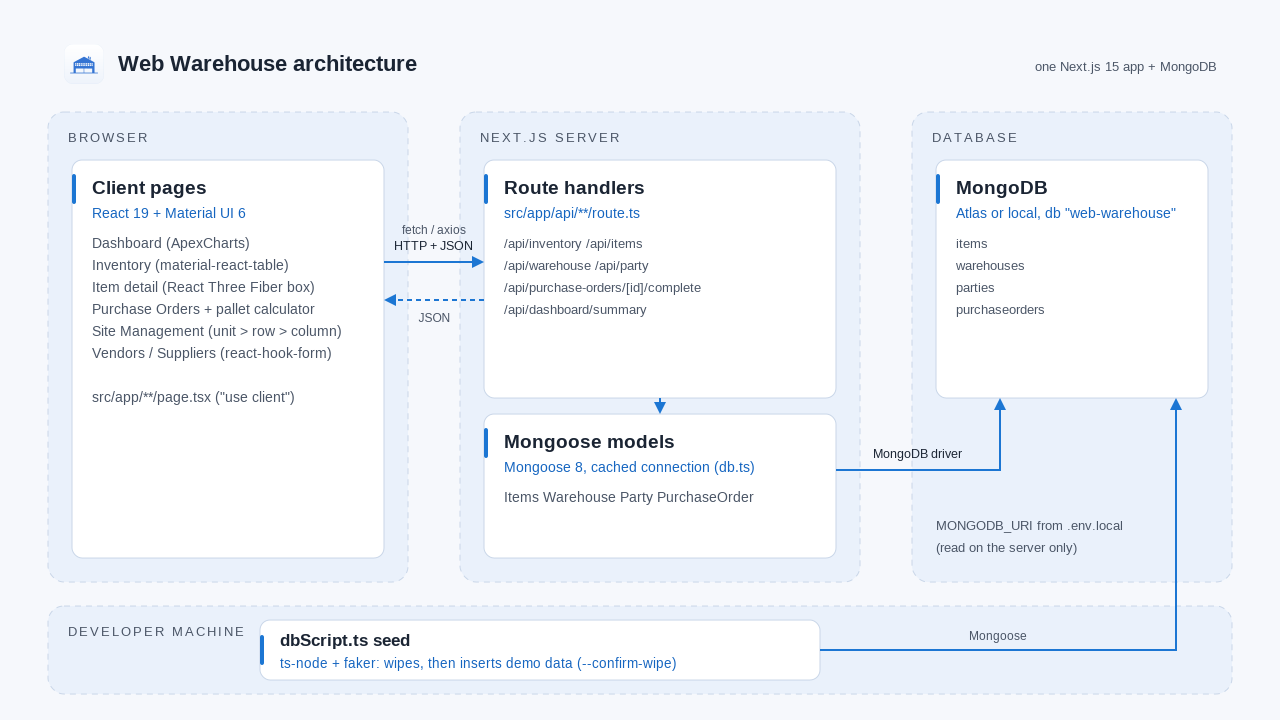
Web Warehouse architecture diagram
Fig. 4 · System architecture

How it’s used

  1. 01Seed the database using the dbScript.ts runner to generate parties, warehouse layout, 50 items, and 10 purchase orders with embedded pallets.
  2. 02Browse the warehouse hierarchy (Unit → Row → Column) and open the 3D preview to inspect item placement in the scene.
  3. 03Create purchase orders assigned to vendors or suppliers, with embedded pallet records tracking storage locations.
  4. 04Review the analytics dashboard for stock levels, PO status, and vendor/supplier activity.

5What got hardTP-SDE-2026 · Web Warehouse

C1

Tables hide space

Problem. A flat inventory table tells you what exists, not where it sits or how full a row is.

Fix. Modelled the storage hierarchy explicitly so the same data could be projected into an interactive 3D view.

C2

Demoing without real data

Problem. A warehouse UI with an empty database shows nothing useful.

Fix. Wrote a seed runner that generates parties, the layout, 50 items, and 10 purchase orders with pallets.

6What I learnedTP-SDE-2026 · Web Warehouse

  1. 01The data model decides what visualizations are even possible; get the hierarchy right first.
  2. 02A good seed script is part of the product: it makes features testable and demoable.
  3. 03Scoping matters: role tiers are scaffolded, and enforcing them everywhere is tracked as its own milestone.

7Where it standsTP-SDE-2026 · Web Warehouse

Outcomes

  1. ›Structured MongoDB schemas for Warehouse, Item, Party, and Purchase Order with embedded pallet support.
  2. ›Interactive Three.js 3D item viewer inside the browser — no external tooling required.
  3. ›ApexCharts dashboard showing inventory metrics and purchase order analytics.
  4. ›Role-ready architecture scaffolded for Admin, Manager, and Employee access tiers.

Milestones

  1. DoneWarehouse schema & CRUD

    Items, parties (vendor/supplier), POs with pallets, and warehouse hierarchy fully implemented.

  2. Done3D item preview (Three.js)

    3D spatial viewer for individual items embedded in the warehouse browse flow.

  3. DoneAnalytics dashboard

    ApexCharts panels for inventory and purchase order analytics.

  4. PlannedRole-based access control

    Scaffolded for Admin/Manager/Employee tiers, not yet fully enforced in UI.

Next

  1. ›Fully enforce RBAC tiers across all CRUD surfaces.
  2. ›Add heatmap overlays for slot utilization and congestion.
  3. ›Introduce path-optimized picking simulations for large warehouses.
Next case studyShipping Agent